Editorial status: AI-drafted text — pending human fact-check. Product facts that name a vendor were checked on official websites on 2026-11-18. We have not done hands-on testing unless a listing’s testing notes say otherwise. This notice will be removed only after a person has reviewed the wording.
A detector score will not tell you whether a piece is accurate or worth publishing. Use official checkers as one pass, then edit and fact-check as a person.
Main keyword: AI detector for editors. This is educational guidance, not legal, academic-conduct or employment advice.
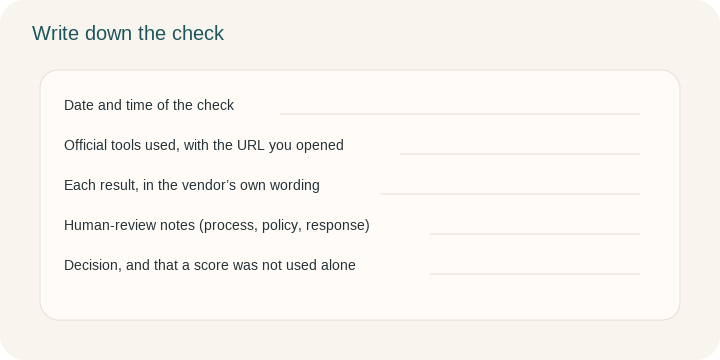
Record which official tools you ran before you publish or send work back. Original diagram.
Set the standard in the brief
Tell contributors what AI use is allowed and how it should be disclosed before the draft arrives. Then, if you check delivered copy, use the shared workflow on the same prepared file: two or three official checkers, a comparison, and a human edit. Official pages warn that AI rewrite tools can themselves affect a score — a relevant issue when copy has been through a grammar or rewrite assistant.
Fact-checking still comes first for publication quality
Google’s official Search Central guidance, last updated 1 October 2026 and opened on 18 November 2026, says generative models predict words and can be inaccurate, and that it is “critical to manually factcheck and review all AI-generated content” before publishing, including titles and descriptions. A detector does not do that job. Google also says generating many pages without adding value for users may violate its spam policy on scaled content abuse, and that you might tell readers how content was created.
If official checkers conflict, do not average them into a publication rule. Talk to the writer, look at sources, and decide against your house policy. This is not legal advice.
Guides in this hub
How to check if text is AI-written — Do not paste once and treat one score as a verdict. Prepare the passage, run two or three official checkers, compare, then review as a person.
Run two or three different checkers — Use official websites, the same prepared text, and two or three tools. Record each result in the vendor’s own wording.
What to do with conflicting results — If official checkers disagree, slow down. If they agree, you still do not have proof. Document what each official site said.
Documenting a check — A short written record keeps a check fair and honest: what you ran, what the official sites said, and that a score was not used alone.
Read the results as signals, not as proof — A percentage or label is an estimate from a model. Official pages say it is not a verdict, not objective truth, and not a decision on its own.
Tools this hub points to
Good for a free official check when you need clear “signals, not verdicts” language — including employment caution
A free official checker (at least 80 words) whose own page says scores are signals, not verdicts, and should not decide academic or employment cases alone.
An official detector inside a writing tool. Official guidance: the percentage is not an objective source of truth, and it may differ from Turnitin, GPTZero or Copyleaks.
Official homepage advertises 20 free credits daily for text, image and video checks. Published accuracy figures are vendor claims, not this site’s tests.
Official page advertises a free AI checker, up to 25,000 characters for free, and limited free credits for new accounts. Official 99% and .03% figures are vendor claims. The official page also notes some Grammarly features can be flagged.
This site stores your cookie choice in your browser (localStorage) so the banner does not keep reappearing. This site uses Google AdSense. Google and its partners may use cookies to serve ads, including personalised ads, based on your visits to this and other sites. You can opt out at Google Ads Settings and www.aboutads.info. Read the Privacy Policy. Datenschutzhinweis: Ihre Wahl wird nur auf diesem Gerät gespeichert.