Good for a no-sign-up student or self-check of a short-to-medium draft
Scribbr AI Detector
Official free checker with no sign-up and a 1,200-word limit per submission. Useful as one of two or three checks, not as proof.
Audience hub
If you use official checkers at all, use them after a published policy, as one prompt among others, and never as the grade or the misconduct finding.
Main keyword: AI detector for grading. This is educational guidance, not legal, academic-conduct or employment advice.
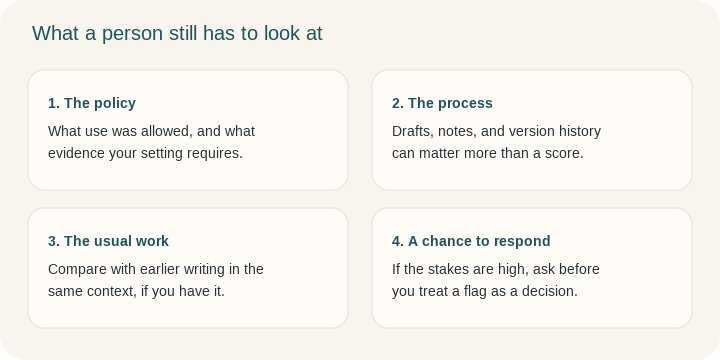
Say in advance what AI use is allowed and how students should disclose it. Turnitin’s official blog starts with “know before you go”: plan for false positives and share expectations. Jisc’s official principles say colleges should give learners clear guidance, train staff if detection is used, and provide a way to contest an AI system’s output. Detection, Jisc says, “may have a part to play” but is “by no means a full solution,” and such tools “cannot conclusively prove text was written by AI, generate false positives, and are easy to defeat.”
If your institution already provides a tool such as Turnitin, follow that official environment and that official guidance. Turnitin’s official blog says the company does not determine misconduct and that you must apply professional judgement because the false-positive rate is not zero. A public self-serve checker is not automatically the same as your institution’s tool. Grammarly’s official user guide warns that scores may differ from Turnitin or other detectors.
Use the shared workflow: prepare the text, run two or three official checkers only if your data policy allows it, compare, then do the human review. GPTZero’s official FAQ says results should not be used to punish students and should start a conversation, and it suggests asking for drafts or revision history.
One institutional example, not a universal rule: the University of Missouri’s official page records a Faculty Council opinion that AI detection reports should not be the sole evidence for reporting students or misconduct proceedings. Follow *your* policy, and keep a written record.
Good for a no-sign-up student or self-check of a short-to-medium draft
Official free checker with no sign-up and a 1,200-word limit per submission. Useful as one of two or three checks, not as proof.
Good for a self-serve education-oriented official check, as a conversation starter rather than a punishment tool
An official self-serve checker. The homepage scan box we opened showed a 10,000-character field, and official pages say results should not be used to punish or as a final verdict.
Official sources cited here say a score should not stand alone, should not be used to punish, or does not determine misconduct. Follow your institution’s rules.