Editorial status: AI-drafted text — pending human fact-check. Product facts that name a vendor were checked on official websites on 2026-11-18. We have not done hands-on testing unless a listing’s testing notes say otherwise. This notice will be removed only after a person has reviewed the wording.
If you review writing in a hiring process, treat official checker results with more care, not less. Official vendor language already says not to make an employment decision on a score alone.
Main keyword: AI detector for hiring. This is educational guidance, not legal, academic-conduct or employment advice.
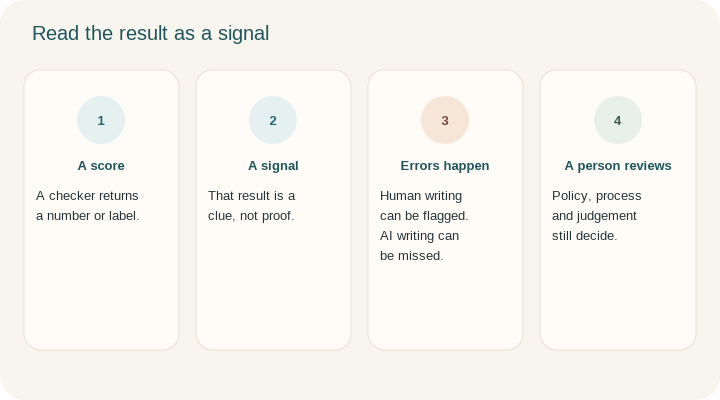
Hiring is a high-stakes setting. Official pages already say a score is not enough. Original diagram.
Official language is already strict
QuillBot’s official detector page, checked on 18 November 2026, says: “Never make an academic or employment decision on a detector score alone.” The same page later says: “Never rely on an AI detector alone when making decisions that could impact someone's career or academic standing.” That is the starting rule for this hub. This page is not legal advice, not employment-law advice, and not a recommendation to screen applicants with detectors.
Other official pages point the same way. GPTZero’s official homepage says results should not be used as the final verdict. Sapling’s official detector page says no current detector should be used as a standalone check. Grammarly’s official user guide says the percentage is not an objective source of truth and should not be a definitive assessment.
If a check is already part of your process
Follow your organisation’s legal, privacy and equality rules first; this website cannot replace them. If you still look at writing, prefer process evidence (a supervised writing sample, a conversation about the work) over an unsupervised official score on a cover letter. If you run official checkers at all, run two or three, document the conflict or agreement, and give the person a chance to respond. Do not reject a candidate on a single paste-in percentage.
Application materials may also be short, formal, or written in a second language — all officially documented weaker or riskier conditions for some detectors. Privacy matters: unpublished applications should not be pasted into a third-party tool unless your policy and the official vendor terms allow it.
Guides in this hub
Read the results as signals, not as proof — A percentage or label is an estimate from a model. Official pages say it is not a verdict, not objective truth, and not a decision on its own.
What to do with conflicting results — If official checkers disagree, slow down. If they agree, you still do not have proof. Document what each official site said.
A human review checklist — After the official scores, look at policy, drafts, usual work and a chance to respond. Then write down the decision.
Handling a possible false positive — If a flag may be wrong, keep the official results, look at process evidence, and give the writer a fair response path. A second checker is context, not a counter-proof.
Documenting a check — A short written record keeps a check fair and honest: what you ran, what the official sites said, and that a score was not used alone.
Tools this hub points to
Good for a free official check when you need clear “signals, not verdicts” language — including employment caution
A free official checker (at least 80 words) whose own page says scores are signals, not verdicts, and should not decide academic or employment cases alone.
An official self-serve checker. The homepage scan box we opened showed a 10,000-character field, and official pages say results should not be used to punish or as a final verdict.
Official free check of the first 2,000 characters, $0/month on the official pricing page. Official warning: no current detector, including Sapling’s, should be used as a standalone check.
Can I use a high official score as the reason not to hire someone?
Official QuillBot wording says never to make an employment decision on a detector score alone, and never to rely on a detector alone for decisions that could affect someone’s career. This site is not legal advice; get advice for your jurisdiction.
This site stores your cookie choice in your browser (localStorage) so the banner does not keep reappearing. This site uses Google AdSense. Google and its partners may use cookies to serve ads, including personalised ads, based on your visits to this and other sites. You can opt out at Google Ads Settings and www.aboutads.info. Read the Privacy Policy. Datenschutzhinweis: Ihre Wahl wird nur auf diesem Gerät gespeichert.